

Magnalia 01: Does The Southern Ocean Have A Pulse?
Plus: an incredible win against cancer & YIKES, that was a hot one.

Hi. This is Mike of Everything Is Amazing, a newsletter that argues where we’re going, we need more of the right kind of idiots.
If you haven’t yet done so, please sign up for maximum idiocy below:
A few days ago I saw this image from the magnificent weird medieval guys (posted here):

What a perfect name that would make for a regular round-up of interesting and hopeful things, I thought greedily.
So, as the title of this newsletter confirms, I’m stealing it.
Either I’ll get away with this, or I’ll be meeting wmg’s Olivia Swarthout in court where I won’t have a leg to stand on and will be quickly and completely ruined. Please stay tuned either way.
In the meantime, here are some incredible things I have been thoroughly wondering at.
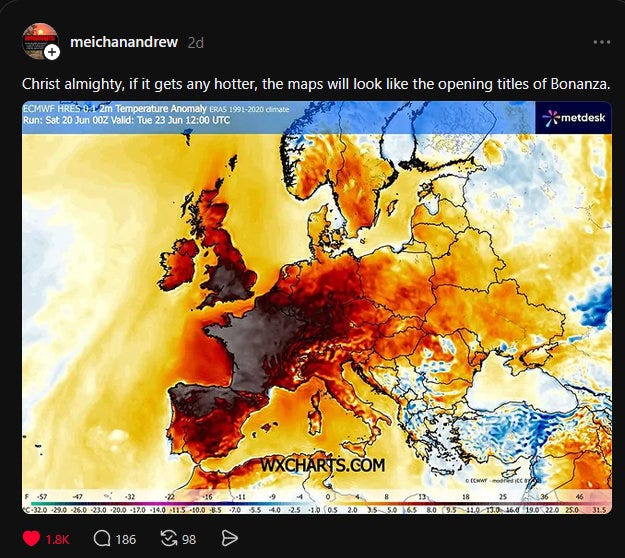
1. We’re Cooking, But Certainly Not Cooked
Well, that was crazy.
On Friday, and for the third day in a row, the record for the hottest recorded June day in Britain was smashed, with Suffolk reaching a truly incredible 37.3C (99.14F).
As for those of you living in France where it was a good 10 degrees hotter - my imagination fails me. Please leave a comment saying you’re okay?
I know all the big news sites adding the obligatory “Is It Climate Change?” explainers are just doing their jobs, but - yes, of course it’s climate change, because just about everything is now (ie. it’s going to have an impact on every part of our lives), and because extreme weather researchers have confirmed this couldn’t have happened without climate change.
It’s also another sign that in years to come, we Northern Europeans can expect our summers to get hotter and winters to get colder, as extreme temperatures become increasingly unexceptional.
That means a lot needs to change - in the way our houses are built or rebuilt, in the way we generate and store energy in preparation for extreme weather, and in the way we use architecture, technology and urban planning to engineer smarter methods of keeping cool or warm, as needed.
Thankfully, there are plenty of good examples to draw upon! In the EU, the Nearly Zero-Energy building standard has been in place since 2020, and in a few years it’ll be enhanced by a Zero Emissions requirement. A key part of both is better “electric and thermal energy storage,” including measures that help get occupants through extreme temperature events like the heat dome over Europe this week. The faster the UK (and elsewhere) fully and successfully implements something like that, the better.
I’m also wondering here about the potential role of ultra-reflective paint and structural colour, as I wrote about previously:
“A team at Purdue University in Indiana has been experimenting with different compounds that absorb less UV light than usual paint materials, and in 2021, they created a paint that reflects 98.1% of all the sunlight landing on it - which means it could cool the surfaces it’s painted upon below the ambient temperature, without aircon. Pretty spectacular!”
Meanwhile, as Bill McKibben just noted, Australia is now so awash with cheap solar energy that its citizens will be getting 3 free hours of electricity every afternoon. It’s not quite a giveaway - it’s also designed to encourage more usage in hours when there’s much more power entering the grid - but as a demonstration of how quickly things are changing, it’s a dramatic one:
“Now, in one large part of the earth, for one large part of the day, electricity will be too cheap to meter. You want some abundance? Here you go.”
There are so many ways that the world can get nudged in a better direction. But when ethical choices also become the most cost-affordable ones - as with China’s renewables revolution (memorably dubbed by WIRED as a “huge mess that might save the world”) driving the cost of solar installation and energy generation down to hitherto barely imaginable lows - that feels like a real turning-point. When even the most ruthless capitalists among us can’t help doing the right thing, you can expect a lot to change for the better very, very quickly.
So yes, there’s a lot going on. But the parts that are encouraging? I remain firmly encouraged.

2. Take THAT, Cervical Cancer
The above screenshot is of the incredible headline the BBC ran last week.
It’s since been changed to “Young women now have ‘close to zero’ risk of cervical cancer death after HPV jab” - and I suspect they did this because of folk yelling AT LAST, A CURE FOR CANCER!
I wouldn’t blame anyone for getting that excited. It’s absolutely warranted! This is the relevant sentence from the study in The Lancet:
“In women aged 20–24 years between 2020 and 2024, in whom vaccination coverage was around 88–90% at age 12–13 years, no deaths occurred, compared with 23.1 expected deaths based on historical rates, corresponding to a mortality reduction of 100%.”
“No deaths”.
“Mortality reduction of 100%”.
Zero.
Incredible stuff. Nevertheless, the authors of the study conclude:
“That is likely to be a chance finding corresponding to a very low underlying rate of cervical cancer mortality in the population, rather than a true eradication of cervical cancer as a cause of death in young women.”
This doesn’t change the fact that yet again, as with this earlier study in Scotland, it’s confirmation the HPV vaccine is already saving lives, and going a long way towards the World Health Organization’s aim of eliminating cervical cancer as a public health risk. If that happened, yes, we could safely say that in practice that’s one type of cancer defeated, sparing hundreds of thousands of women a truly devastating amount of suffering.
In other news, here’s a promising new genetically engineered virus therapy that can infect & kill brain cancer (!), making it easier for cancer-fighting immune cells to infiltrate glioblastoma tumors. Absolutely amazing.
So no, there’s not yet a ‘cure for cancer’, in that widely-understood sense. But it really does seem like we’re getting near at last.
3. Wait - Is That A Pulse?
A few months ago, Brendan Leonard sent me a message:
“Hilary Oliver sent me this last week and I immediately thought, “this is some Mike Sowden shit right here.”
Accompanying it was a link to a piece by Marian McKenna of the Montana Natural History Center, titled “I saw the Earth breathe.”
Here’s an excerpt:
“As I was about to stand up, I saw or felt a slow movement on the surface of the earth. This movement, a very gentle lifting, carried all the way to the horizon. I stayed rock still. Was I feeling or seeing this phenomenon? Nothing on the surface of the earth moved. It was a very infinitesimal lifting as if the earth was expanding with breath, contracting in a sigh. In that moment, I had no understanding of what I was seeing and feeling. Was it even real?”
I’d just spent an hour fighting through some stridently pro-AI essays in the run-up to writing this, and I’d had more than my fill of fanciful hyperbolism for the day. No, Marian, my inner voice shrieked like an exasperated David Mitchell. Let’s all get a grip here, shall we? It obviously didn’t happen, because the idea that it did happen is, quite clearly, absolute balderdash.
Possibly anticipating this reaction in many of her readers, McKenna quickly continues:
“Telling a colleague about this experience, she shared with me that the scientific community discovered what they are calling a “26-second pulse” in the early 1960’s".”
This statement is in fact entirely correct, and I had no idea. (Thanks, Marian! Sorry I was sounding like a jerk back there.)
This mysterious pulse was first noticed by researcher Jack Oliver (who I think is the geophysicist John E. “Jack” Oliver) of the Lamont-Doherty Earth Observatory in Palisades, New York in the early 1960s - “a worldwide storm of microseisms with periods of about 27 seconds.”
A microseism is a tiny vibration of the Earth’s surface, just strong enough to show up in seismograph readings as chaotic background noise that needs filtering out. However, this one was a faint but unmistakable recurring pulse, strengthening in the Northern hemisphere during its summer months, while almost - but not quite - dying away during its winter.
If you’ve been reading me for a while and that sounds familiar, yep, this is where my thoughts went as well:
For Nine Days, The Earth Rang Like A Bell

A seismometer in the Arctic recorded it. Another in Antarctica registered its presence. It could be detected everywhere - and it wasn’t hard to spot against the normal discontinuous background noise of our planet bending, cracking, heaving and erupting in fabulously complicated ways, because this was a single vibration frequency, as regular as a metronome.
For over a week, the Earth chimed like a struck bell. One pulse every 90 seconds, every hour of every day, for 9 days.
But then in 1980, USGS geologist Gary Holcomb took a closer look at the data:
“During storms, the amplitude of this ground motion increases to high levels which allows detailed studies of its characteristics. Analysis indicates that the energy arrives as Rayleigh waves from a source in the southern Atlantic Ocean.”
It seems the explanation wasn’t as ‘simple’ as a glacier-triggered standing wave. (Note the inverted commas, because I do not want to disrespect the incredible detective work of the geologists who discovered the recent Greenland and Alaska megatsunamis.)
It seemed something else was happening. But what?
In 2005, grad student Greg Bensen stumbled over the same signal in his work at the University of Colorado. Working with his advisor, he triangulated it to single source somewhere in the Gulf of Guinea, off western Africa.
Weirdly, this is the body of water where Null Island is located! It doesn’t seem this is relevant to this story, but if you’re in need of a new conspiracy theory to keep yourself busy in a vaguely unhealthy way, please take this with my non-liable blessing.
Rediscovering Oliver & Holcomb’s earlier work, Bensen then teamed up with co-authors M.H. Ritzwoller (said advisor) and N.M. Shapiro to publish this paper in the journal Geophysical Research Letters.
Now - if you’re looking for a kind of breathless X-Files style narrative arc here, with obsessed investigators stopping at nothing to uncover the truth - unfortunately, here in the real world, all this stuff needs funding.
As a layman, one thing I found surprising about the Greenland BONG BONG BONG story was that most of everyone involved worked on it in their spare time, as a couple of its geologists confirmed to me on Bluesky when my take on the story went viral. I’m sure this wouldn’t be news to any working scientist. However intellectually stimulating it may be, does such a mystery hold the promise of, for example, quantifiable commercial value? Nope. Did those scientists actually need to work on stuff that, you know, paid their monthly bills? Yup. And so on.
So maybe that’s why even today, this tiny pulse remains unexplained. It’s probably the result of massive winter storm waves battering against the African continental shelf in a place called the Bight Of Bonny - and if so, that’s another reminder of the incredible energy water can throw around when it’s on the move. (Never forget the violence unleashed by the Storegga Slides!)
But 60 years after this pulse’s discovery, nobody has confirmed this for sure.
Via science writer Anna Funk’s brilliant write-up of this story for Discover Magazine in 2020:
““We’re still waiting for the fundamental explanation of the cause of this phenomenon,” says Ritzwoller. “I think the point [of all this] is there are very interesting, fundamental phenomena in the earth that are known to exist out there and remain secret.” It may be up to future generations of students, he says, to truly unlock these great enigmas.”
And if you’re worried it’ll be forgotten and require rediscovery all over again, fear not - its immortality is now sealed with its own xkcd cartoon:
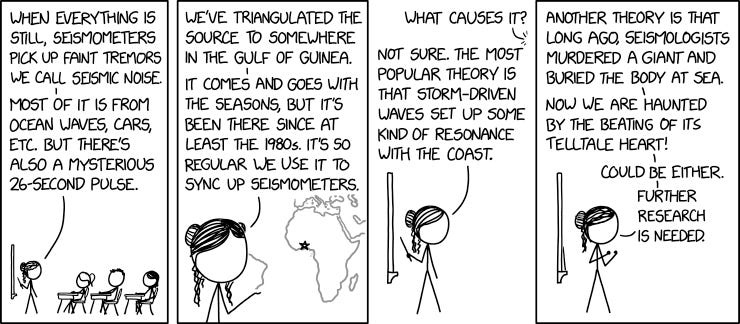
(A tip to all science postgraduates looking for a topic for your thesis: just pick your way through the xkcd archives until you find something suitable. I mean, look what happened with Time and all the new discoveries about the Zanclean megaflood!)
As for Marian McKenna, right now she’s perfectly happy not having all the answers:
“I think I like the idea that we don’t exactly know what is causing this pulse that can be located and recorded. I don’t even know if this mysterious pulse is what I experienced. For me, the earth was breathing that day as I lay in the aspen grove. It’s enough. I shared a moment with the living, breathing earth.”
Maybe some mysteries are worth sitting with, like Rebecca Solnit’s ‘blue of distance’ - not just “a problem to be solved" but a thing to be enjoyed as the curiosity-tickling question that it currently is?
If so, this will do nicely.
Thanks for reading,
Mike
Images: MatheoJBT; Joshua Chehov; weird medieval guys.
As ever - bright light everywhere, Mike. Thank you!
I’m in France (Paris), survived but it was a difficult week.