

Wait, What's That Cold Blob Doing?
And other jaw-dropping science stories from the shallows and deeps.

Hello! This is Everything Is Amazing, an enthusiastic caper through the modern sciences in search of a good “wow!” you can feel all the way to your [redacted]s.
In today’s edition, I’m once again channellling a bit of Season 4, by looking at a few remarkable discoveries within (and under) the two-thirds of our planet covered with water.
To get us started - wait, what the hell is that?

Yes, that blue patch’s name is indeed the Cold Blob (or, in some publications, the North Atlantic Warming Hole).
I do love modern science’s willingness to use the rather silly word “blob” - a word you can imagine Rowan Atkinson getting his mouth around with great relish - in all sorts of serious work, like the “blob of nightmarishly gigantuan proportions” far under our feet right now.
When I recently wrote about the incredible natural wonder called the Denmark Strait Cataract….

…I stumbled over the fact that the coldest water in the Atlantic is in the vast basin of the Irminger Sea, 4.8 kilometres deep, which the Cataract empties its polar water into. Aha, yes, I smugly thought to myself, that must be the reason for this ‘Cold Blob’ I’ve seen mentioned - cold water is denser than warm, therefore it sinks, so of course this crater-like expanse collects cold water. Simple physics!
What I’d got wrong is the Cold Blob is surface water, not the deeper stuff. That’s what’s so weird. While the seas around it are heating up, the Blob is getting colder, and has been for the last century.
Okay then. What’s going on here?

It’s all about what that water contains. Jono Hey at Sketchplanations hit upon the answer a few days ago, in his piece about thermoclines:
“Also affecting ocean layering is salinity—how salty the water is. Salty water, as well as colder water, is denser than fresh water and so will tend to sink beneath it.
Ever since the incredible “underwater lake” in BBC’s Planet Earth, I’ve been meaning to sketch a halocline, the change in density when fresh and salt water meet.”
The water coming in from the Denmark Strait is partly melting ice - which is fresh water, at least relative to the surrounding ocean. As it enters the region of the Cold Blob, the fresh(er) water stays on top of the cold-but-salty water, and so the Blob gathers and lingers.
As I understand it, that’s only part of the reason. The other, much more concerning factor (not that melting polar & Greenland ice isn’t concerning!) is all this Atlantic water just isn’t moving like it used to.
Our planet’s seas move according to the thermohaline circulation (THC), a vast array of surface and deep-water currents that transport water, heat and nutrients around our planet. The main Atlantic component of this is called the Atlantic Meridional Overturning Circulation - and because of global warming, the AMOC is increasingly showing signs of running amok, moving smaller and smaller amounts of heat and salt into the north Atlantic.
It’s now looking increasingly likely that over the next few decades, this circulation system could either slow down or come to a complete stop - with potentially dramatic changes for the climate, including greater temperature extremes from season to season in Europe and elsewhere.
(Here in Scotland, the Institution of Engineers is already considering the challenges this would bring onshore & offshore, including unusually brutal winters.)
What’s being actually done to fix this is, of course, fiendishly complicated to track - but I think it’s important to gravitate towards the voices highlighting the very real positive steps now underway, like Katharine Hayhoe, Bill McKibben and Sam Matey-Coste, rather than relying just on anxiety-inducing news headlines that tend to cater to our negativity bias.
However, some suggestions are so wildly bonkers that you can’t avoid them - like this one:
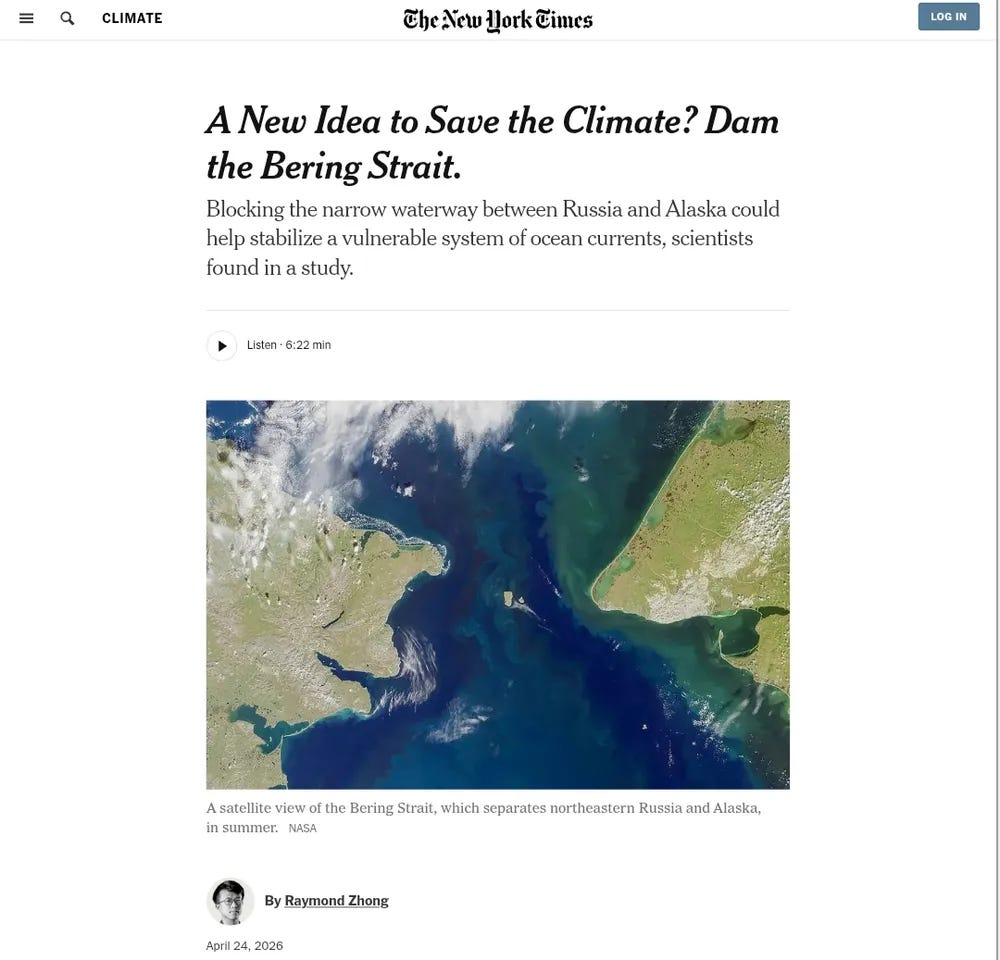
(Here’s the paper, published in Science Advances last month.)
Uh. Wait. Isn’t that….isn’t that basically another version of….?

Yep! It’s the thundering madness of Atlantropa given new life.
In some ways this would be easier to build than Sörgel’s monstrosity, and not just due to a century of technological progress - for example, the Bering Strait is on average a lot shallower than the Strait of Gibraltar (30-50 metres vs 300-900 metres).
However, the individual sections of a Bering Strait dam would have to be far longer than an Atlantropan dam at Gibraltar - and that’s despite using the two islands (Big Diomede and Little Diomede) as connection points.
Putting aside the fact that Little Diomede is populated by Alaskan Inuit, and the further fact that these are violently energetic seas being squeezed through a relatively tight space, and the even further fact that (as is often the case geoengineering proposals this ambitious) nobody knows exactly what environmental chaos this might unleash in practice - well, it certainly won’t be the last “hooray this will fix everything!” megaproject we’ll see proposed and excitedly jumped upon by the big newspapers.
Those headlines will keep coming, no doubt to the delight of those who profit from how such proposals distract from more impactful long-term solutions (*whispers* it’s about the greenhouse gases, guys).
But there’s still a tiny part of me that likes the gonzo ambition at work here. As I did with my writeup of Atlantropa, I’ll once again quote Cal Flyn, author of Islands Of Abandonment and the upcoming The Savage Landscape: How We Made the Wilderness, who wrote for Prospect Magazine about the power of big, imagination-intoxicating stories of change that could rally us into collective action:
“A quotation, commonly attributed to the writer and pioneering French aviator Antoine de Saint-Exupéry, says: “If you want to build a ship, don’t drum up people together to collect wood and don’t assign them tasks and work, but rather teach them to long for the endless immensity of the sea.” This, if I ever read one, is a manifesto for nature writing in the present day. This is our own task: to evoke the experience of being in this wild and beautiful world. To stir people to love the planet with a jealous passion, to act in a way more befitting of a custodian or even lover. Go in through the heart, and the head will follow.
We need to be roused. We need to feel. We need a siren song that lures unsuspecting souls to the cause: a song to enchant us, to put us to work.”
Read on to learn about:
A “collapsed crème brulee” taller than Australia…
…an 2025 Alaskan wave nearly half a kilometre high…
…and a whole new way to see underwater!