

Beyond Our Peripheral Vision: Part 1
Welcome to Substack's first semi-aquatic audio essay.

Hello! This is Everything Is Amazing - and based on today’s edition, who knows what it is?
Nevertheless, if you’re not a subscriber, please sign up below (if only out of morbid curiosity):
This one is best listened to - I must have aged myself ten years recording it for you. Nevertheless, there’s a transcript below.
Oh, hello.
The other day, when it was 28 degrees Celsius outside here in western Scotland, I had an absolutely brilliant idea.
For the past week I’ve been going swimming in the sea pretty much every day - it’s pretty easy to do here, there’s a stretch of sandy beach a half-hour’s walk from my flat that slopes very gently down into the Firth of Clyde, and when the sun’s out and the tide is high, all that water gets baked by the sand underneath it until it’s as warm as bathwater. You can splash your way into the shallows, sit down in one of the warmest bits, let your body get used to the idea, then go venture further out where the water’s a bit deeper and colder.
My brilliant idea - and let’s be clear, this is a brilliant idea - was to do this while recording the first part of my next newsletter.
Has anyone else done this? No! This would be Substack’s first semi-aquatic audio essay. I would be celebrated from one end of the platform to the other. What a brilliant idea, people would say.
And as I got deeper and the water explored new areas of my anatomy, I would be forced to utter things like ooooh and ahhhh. Comedy gold!
The one tiny flaw in my brilliant idea is that I was doing this in Scotland. Scotland is a place where the weather is utterly unpredictable - and there I was, unthinkingly making predictions about it, eg. good grief, it’s absolutely baking out there right now, so of course in a few days - which, let’s face it, is only a few days away - it will also be a similar temperature. This is a heatwave, for pity’s sake. And it’s the end of June! There’s literally no chance that it’s going to be as cold and windy as it was just 2 weeks ago - despite it being June back then as well.
Well. Here I am.
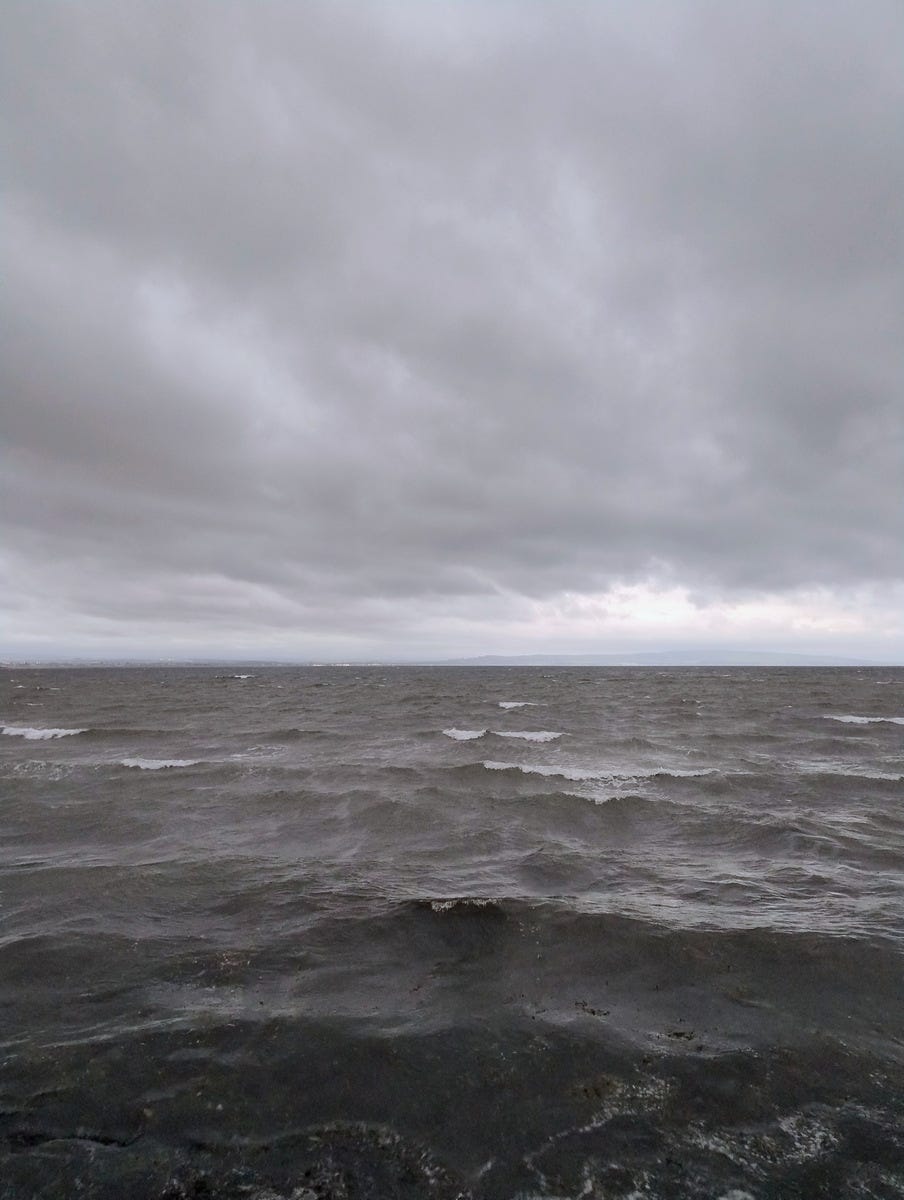
It’s early afternoon on Monday, it’s a good 10 degrees colder than it was on Friday, there’s an icy wind blasting up the beach from the direction of Northern Ireland, and having already tested the water, I can confirm it is baltic.
Once again, I’m taking what might be a brilliant idea at another time, and turned it into yet another cautionary tale for other newsletter writers - but to hell with it, I’m doing it anyway, and if the worst that can happen is what’s actually going to happen, I might as well just get it over with.
This, then, is a paywalled two-part story. Today, you get this, and tomorrow (or maybe the day after), if you’re a paid subscriber, you’ll get the other half - which I will hopefully be recording at home, having fully recovered from what is about to happen to me.
Here we go!

In 1908, Scottish electrical engineer and fellow of the Royal Society Alan Archibald Campbell Swinton sent a letter into the journal Nature, which its editor duly published.
It read as follows:
Distant Electric Vision
“Referring to Mr. Shelford Bidwell’s illuminating communication on the subject published in Nature of June 4th, may I point out that though, as stated by Mr Bidwell, it is wildly impracticable to effect even 160,000 sychronised operations per second by ordinary mechanical means, this part of the problem of obtaining distant electric vision can probably be solved by the employment of two beams of kathode [cathode] rays (one at the transmitting and one at the receiving station) synchronously deflected by the varying fields of two electromagnets placed at right angles to one another and energised by two alternating electric currents of widely different frequencies, so that the moving extremities of the two beams are caused to sweep synchronously over the whole of the required surfaces within the one-tenth of a second necessary to take advantage of visual persistence.
Indeed, so far as the receiving apparatus is concerned, the moving kathode beam has only to be arranged to impinge on a sufficiently sensitive fluorescent screen, and given suitable variations in its intensity, to obtain the desired result.
The real difficulties lie in devising an efficient transmitter which, under the influence of light and shade, shall sufficiently vary the transmitted electric current so as to produce the necessary alterations in the intensity of the kathode beam of the receiver and further in making this transmitter sufficiently rapid in its action to respond to the 160,000 variations per second that are necessary at a minimum.
Possibly no photoelectric phenomenon at present known will provide what is required in this respect, but should something suitable be discovered, distant electric vision will, I think, come within the region of possibility.”
- A.A. Campbell Swinton, 66 Victoria Street London, S.W., June 12 1908.
What he’s talking about, of course, is television - a good two decades before the war of battling patents that birthed the first commercial TV sets.
But before that was actual war, the Great War that engulfed Europe from 1914 onwards - and it was this time of intense and rapid innovation in the field of wireless technology that paved the way towards this new industry.
Alas, Campbell Swinton didn’t really benefit from any of it. He shared his ideas widely and with enthusiasm, yet patented nothing - perhaps thinking that since he hadn’t discovered cathode rays himself - that honour belonged to a couple of German physicists - or the cathode ray tube (CRT) - that was Ferdinand Braun in 1897 - then maybe he didn’t have the right to make a claim.
He died in 1930 at the age of 66, having never seen a working cathode ray tube display, the basis for the very first commercial television.
What Campbell Swinton also helped bring into the world is what we now know as the screen - a mostly flat, slightly served surface, lit from behind, completely refreshing itself anything upwards of 30 times a second, more often than not 60 or 120 if it’s a phone, and creating the illusion of a moving picture that looks like you’re gazing through a window.
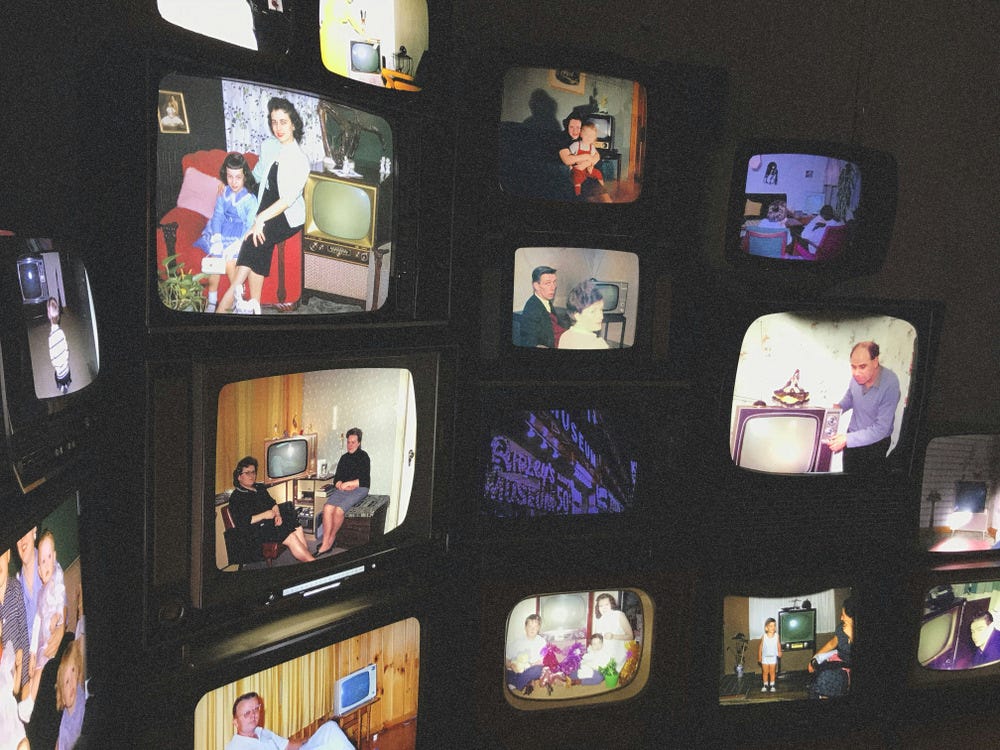
But the thing about windows is - you’re on one side of them, and the thing you’re looking at is on the other side.
I know most discussions about the danger of screens this day focus on the way we never turn them off, or the unreal ways they can skew our view of the people we see on them - but there’s also the window-like qualities themselves.
A window makes you feel distanced, peripheral, to whatever you’re looking at - and, isn’t it interesting that we use that same word for all our gadgets, when it also means “at the extreme edge of things?”

In this season of Everything Is Amazing, I’m writing about the effect of the outdoors on our psychology and wellbeing - and one thing I find really interesting is how completely and utterly edgeless the real world is, compared to the artificially bounded confines of all our interfaces with the virtual world. All those windows we’re anxiously pressed up against.
What’s that doing to us, and to the way we’re connecting, or fail to connect, with the wider, unbounded world around us?
Let’s take a look!
Part 2 to follow soon.
Wow. A) because you trusted the Scottish weather, and B) because Swinton's first paragraph is, unless I'm mistaken, all one sentence.
I'm 5 minutes in and this is the best reading I've ever heard...I can feel the cold, lol