

Why It's Fun To Actually *Do* Something
"Unwilded" and the everyday fight against Shifting Baseline Syndrome.

One of the dangers of writing a newsletter about the wonders of science is sometimes you stumble over an idea you just can’t get out your head.
The one currently haunting me (thanks to writing this piece about the 4,900 year old Prometheus) is: why can’t we just plant a few billion more trees?
I understand it’s not an all-encompassing solution in itself, and I also know it’s a complicated issue - but considering what we already know about what a living tree brings to the human world, especially within inner cities desperate for something to get in the way of sunlight before it’s absorbed by all that concrete - can’t we just find a safe but meaningfully scaled-up way to test this idea, right now, to see what happens?
This has put me into a state of heightened tree awareness when I’m out for a walk. I’m often confused when I see a tree on a street I’ve walked down hundreds of times, hardly seeing what’s there. Woah! When did they put that up? And - why is it so utterly alone?
For this reason, I was delighted to discover the concept of the Tree Equity Calculator in Unwilded, the new book by Alastair Humphreys:
“Whether you live on a street with lots of trees or none at all, you are likely to consider it normal and therefore underplay its impact. This is why tree equity calculators matter. They measure how fairly trees are distributed across neighbourhoods, estimating how many are needed to reach a local target and how urgently they are needed, based on economic, cultural and environmental factors.
Tree equity scores turn my gut feeling from scanning a street into measurable numbers, highlighting the areas most in need of investment. Alongside this, the 3-30-300 rule is an urban greening guideline that sets out what fair, everyday access to nature should look like: everyone should be able to see three trees from their home, live in a neighbourhood with 30% canopy cover, and be within 300 metres of quality green space.
A neighbourhood’s tree cover is a slow story that we inherit, but it is also one we can consciously rewrite through our choices about what to leave the next generation.”
(As luck would have it, this thinking is echoed in a beautiful piece by Melissa Harrison published this afternoon, which includes the line: “None of us will see the outcome, but while we are alive we can put some of our energy into improving the health and resilience of our local area, and in so doing so we can influence the future.”)
According to the map on the Tree Equity Score UK website, my street here in a seaside town here in Scotland needs a bit more of that kind of energy invested in it - scoring just 61 points, comparable to the more barren areas in the centre of nearby Glasgow, and only one point above the land covered by my nearest airport. Yikes.
But other than sending infuriated letters to local politicians, what can any of us members of the public actually do about this?

This is why I always enjoy reading anything by Al Humphreys. There’s always a point in his books where you can sense him losing patience with societal apathy, with disheartening statistics and with the glacial speed of modern bureaucracy, cursing loudly while he drags his boots on, to stride out his front door in search of something to actually do, for pity’s sake.
Like his bestselling Microadventures, this is very much a book about taking action, about why it’s so important to do that, and how immensely satisfying, empowering and anxiety-reducing that process can be.
It’s also about learning what’s beyond your narrow horizons in time, and the concept of Shifting Baseline Syndrome, the process by which each generation fails to see the radical changes in its environment because it can’t look beyond its own fleeting existence.
To make yourself aware of what’s changed can be unsettling, sometimes even horrifying. It’s to Al’s credit that this is a book that stares this disheartening process right in the teeth, yet still manages to leave you energised at the thought of stepping up in a spirit of hopefulness and curiosity, to discover what ground might be reclaimed from what’s been lost. In this sense, it’s a book that sees hope as Rebecca Solnit does, as “an axe you break down doors with in an emergency.”
(To be clear, in case Al’s legal team is twitching: there’s only one actual axe in the book, and it’s in the first chapter, where two profoundly nature-disconnected men decide it would be a glorious lark to chop down the tree at Sycamore Gap - as seen on Unwilded’s cover. That’s the cautionary tale that the rest of the book rails against.)
I particularly enjoyed the final third of the book, where Al takes a look at where other environmental writing gloomily leaves the reader at this point - and decides he’s having none of that:
“What I needed was less of the despair that often accompanies conversations about the environmental crisis, and more positive action. I began thinking of the better world we could build, and that was far more motivating. The great reconnection we need with the living world demands positive action over pessimistic paralysis - getting on with pragmatic, hopeful solutions that also improve our lives and are rewarding to be part of.
It can be tempting to excuse ourselves from rolling up our sleeves and getting stuck in because we are not a billionaire, scientist, politician or extrovert. But each of us has different strengths, connections and passions, which means we can all contribute in our own way. And if enough of us do something, perhaps we can be the first generation in history to leave the earth in a better state than we found it.”
In challenging himself to create a long list of nature-related issues he cares about, and narrow it down to just five he’s willing to act upon, he gives the reader a detailed roadmap for doing the same - a refreshing and inspiring way to end a book like this.
In my case, it seems I really care about tree-planting! And after seeing this chart today from Our World In Data…
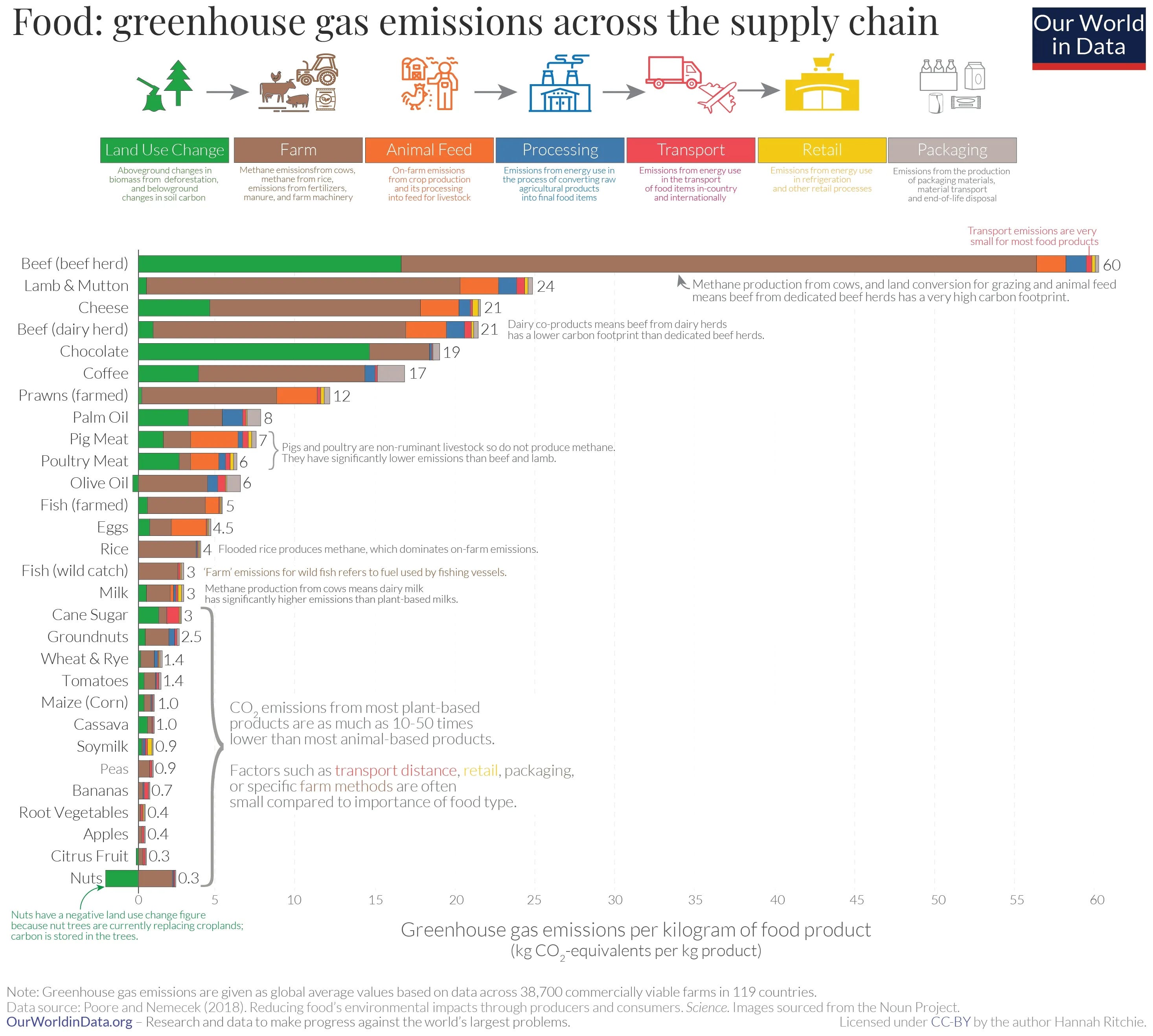
…well, I’m already mostly pescatarian, so it’s no great hardship for me to cut beef from my diet completely. (And it seems I’m not the only one - although that decline might have more to do with rising meat prices.)
That’ll be two of my five, then. What else can I throw myself at?
Unwilded is a really entertaining kick in the pants, delivered with a great deal of cheerful enthusiasm and the determination to treat the challenges of a changing world as, well, challenges - things you can find creative, fun and satisfying ways to pit yourself against. I enjoyed it a ton. I think you will too.
Get your copy of it by clicking below:
And if you want to hear Alastair explain what it’s about in his own words (and probably do a much better job than I have here!), I’ll be having a live chat on Substack with him tomorrow, Tuesday 28th July, at 8pm UK time (3pm EST).
Just visit my Substack profile at the right time, and you’ll be able to tune in.
See you there!
The UK has a tree sponsorship scheme called Trees For Streets https://www.treesforstreets.org/
Residents (and businesses) sponsor trees in their local area, which are then planted by the council if the chosen favoured spot is suitable. Each tree has one or more Tree Champions that take responsibility for watering the new trees.
In my part of London, the costs are £170 (if I water it) or £275 (if the council waters it) for a 3-4 metre staked and tied nursery stock standard tree.
Planting trees is brilliant! I must’ve planted hundreds in my life. But it is just as important to look after the trees that have been planted. Brian May (yes, that Brian May) paid for thousands of trees to be planted near where I live in Dorset. And then they were just left. There wasn’t as much money to look after them. 10 years later when I moved to the area I saw a forest of plastic tubes and trees that were struggling.
Now every Sunday morning I meet up with other women of a certain age and we release the trees. It’s very rewarding as we can already see the effect in patches of this young woodland.
https://youtube.com/shorts/wg3yfitujBU
Trees are ace.